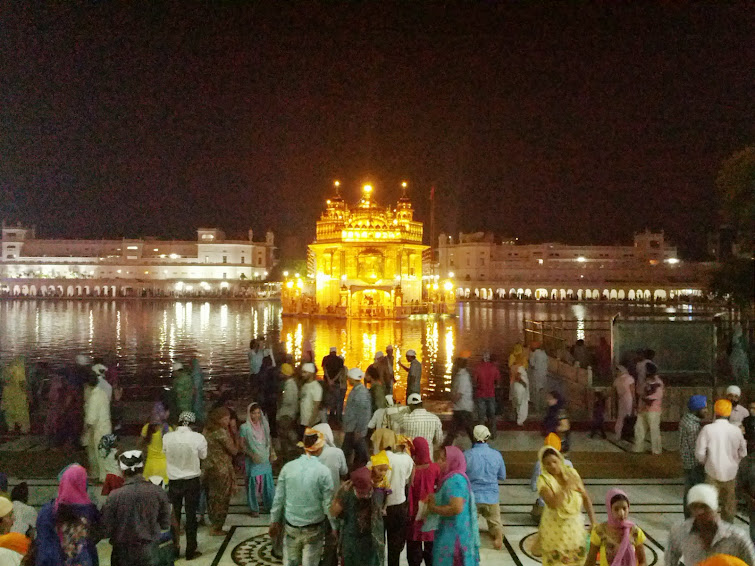
Despite it's status as my motherland, I never felt a strong draw to come to India. When I knew I was coming to Asia, I added it to the long list of countries I planned to visit because... you can't go to southeast Asia and not visit India. My original plan was to spend eight days here. I had it all mapped out. A day here, a couple days there, eight in total and then I'd be off. I ended up spending 27. And not because India was that particularly great, honestly. A lot of it had to do with poor planning on my part, and forgetting to take into consideration the amount of time it would take to travel. I mean... India is BIG. Like... really big. Let me put this in perspective for you:
This all seems so obvious, but it worth saying aloud. India isn't this singular entity of India like I used to think about it as from half-way around the globe in my comfy San Francisco apartment. The different parts of India are very, very different. And I wanted to make sure I saw all of the things I had originally set out to see, from the north all the way through the south. Which meant I was here for a month. I still didn't see everything. Some places I wish I had spent less time. Other places I still didn't get to see at all. But overall, I'm happy with the way this trip turned out.

I grew a lot as a traveler as well. This is my first time traveling outside of the country on my own and I needed to prove to myself that I could do it. And I did. (To some extent. I still knew people in a few places here who helped me out along the way. I think Cambodia will be the real test though. I don't know anyone, don't speak the language, and don't look like the people.) I booked hostels, navigated transportation, made friends, organized my own trips, fed myself, washed clothes, (washed myself!), kept myself relatively healthy, changed money, avoided getting mugged, avoided getting arrested, exposed myself to new cultures and experiences, and became a lot more comfortable with being on my own. I was sick here. A lot. And it rained here. A lot. And I got cheated here. A lot. I could have gone without all three, but I do think they contributed to the sense of "if I can do this, I can do anything" that I'm taking with me from India.
50 Things I hadn't done a month ago:
1. Lived out of a backpack for a month straight
2. Worn the same two sets of clothes for a month straight
3. Visited a Hindu temple
4. Took part in a Hindu religious ceremony
5. Walked through the streets barefoot
6. Saw the home of Mother Teresa
7. Went to Victoria Memorial
8. Explored an Indian slum
9. Got a shave
10. Ate a cheese naan
11. Celebrated a birthday by myself
12. Taken a train for 24 hours
13. Used an Asian-style toilet
14. Stayed in a hostel
15. Made hostel friends
16. Ate a Maharaja Mac
17. Used Indian rupees
18. Purchased a foreign phone
19. Rode on the back of a motorbike
20. Visited Jama Masjid
21. Almost got arrested
22. Visited the Red Fort
23. Climbed over a barbed-wire fence. Twice.
24. Got lost in an urban jungle
25. Had the best biryani in New Delhi
26. Rode in an auto (the Indian kind)
27. Meditated in the Lotus Temple
28. Visited the Taj Mahal
29. Learned how hand-crafted rugs, marble work, and tapestries are made
30. Visited Qadian
31. Went to Bahishti Maqbara
32. Visited Hoshiarpur
33. Climbed up the White Minaret
34. Visited the Golden Temple
35. Fell asleep in the Golden Temple
36. Rode in the back of a van with a malfunctioning door
37. Saw the Attari border closing ceremony
38. Went to the premier Indian vacation spot, Goa
39. Befriended an Indian shopkeeper entrepreneur
40. Went to the land of my people (maybe), Kerala
41. Became someone's first international friend
42. Saw a Kathakali show
43. Went to Jewtown
44. Got an Ayurvedic massage
45. Took a 6-hour cab ride
46. Went to an Indian hospital
47. Stood on top of a waterfall
48. Visited the Connemara Tea Factory
49. Went on a spice walk
50. Rode an ELEPHANT
 |
| India's outline superimposed on the United States ... and some of Canada... and some of Mexico (via buzzfeed..com) |
A lot of what you hear about India is totally true. There is poverty everywhere. Everywhere. People talk about how in India you can see the extremes of wealth butted up right next to each other. My friend KB explained that the reason you see slums surrounding multi-million dollar homes is because the people that live in those slums are the people who built those mansions, so they live close by out of necessity.
I'm reminded of an episode of The West Wing where Donna goes to visit Gaza and is reporting back to Josh. "When you get... into the streets, what hits you about Gaza isn't the overcrowding or poverty. What strikes you is something else: idleness. The sense of the people waiting but with no expectation. It's hard to convey."
I'm reminded of an episode of The West Wing where Donna goes to visit Gaza and is reporting back to Josh. "When you get... into the streets, what hits you about Gaza isn't the overcrowding or poverty. What strikes you is something else: idleness. The sense of the people waiting but with no expectation. It's hard to convey."
I'll caveat all of this by saying that while I was here for almost a month, my interactions with the locals were almost exclusively limited to transactional encounters: hostel proprietors, shopkeepers, waiters, cab drivers, ice cream guys, and ticket sellers, so that likely is coloring my perspective on the situation. But I saw a lot of people here who don't seem to have a lot to do. I don't even know that "idleness" appropriately captures it. I think "resignation" is better. People seemed resigned to live the hand they've been dealt. Even the shopkeepers sit outside of their shops all day, waiting for the couple of sales they might make in a day and not doing much else beside talking to the shopkeeper next door. I guess it's no different than a lot of places in the U.S. but somehow it feels... sadder because it's in India.
There's also a sense of comradery and intimacy among the people here that you don't see in the U.S. Complete strangers talk to one another as if they've known each other their whole lives. People can sound like they're arguing when really they're just having a normal conversation.
I can imagine that it must be incredibly difficult to be a woman here. Most everything seemed to be done by men. Occasionally there'd be a woman in a position of authority, but they were few and far between. Rape was a topic that was a common occurrence in the news. I honestly don't think it's any worse a problem here than it must be in many other parts of the world, but I think it get's a little more attention here because 1) I think there's a bigger international spotlight on India than there is on a lot of other countries, and 2) India is a lot bigger, so as a sheer numbers game, it happens more often here than in smaller countries, but still makes national/international news. Still, I met plenty of female travelers who told me about how many people they knew were shocked and scared to learn that they were traveling by themselves through India.
The servant class is fascinating to me here. Like in Bangladesh, it's totally normal to have servants and drivers here. While staying with KB, I heard her explaining to one of her servants about how the Earth revolved around the sun. This servant was a teenage girl. It's hard to say how much of her lack of educational opportunities had to do with her being female and how much had to do with her just being part of a lower class, but in either case, it was maddening and saddening to see. Servants don't even really interact with the people the serve, outside of anything transactional. They might talk a little, but not really. They're there to serve, not be friends. It's amazing. Amazing in the "I'm amazed that that's how this works," not amazing in the, "this is awesome!" sense.
Personal space and personal hygiene are also very different here than they are in America. By personal space, I really mean lack thereof. There are no physical boundaries between the people here. When you're waiting in line, the person behind you is always pushing your forward. And not by accident, they are actively pushing you forward, even if there is no place forward for your to move. It's not rude in this culture, it's just how it is. Body odor is also all around you. I never got used to it, but it also wasn't as bad as I was expecting it to be in most cases. But sometimes it can almost knock you off your feet. No one here seems to notice.
I ate with my hands more and more as the trip went on. If you've never eaten a full meal with your hands before besides buffalo wings, I highly recommend trying it at least once. You feel connected to your food in a way that you don't get when you're one step removed when using utensils. You get to know your food on a deeper level. The consistency of it. The temperature. The texture. It adds a completely new layer to one's gastronomic experience. If you do try it out, don't be shy. It's not like eating a bag of Cheetos where you try to only use two fingers to minimize the amount of Cheeto dust you have on your hands. You've got to dive right in. Get a little messy. Remember, you're going to wash your hands when you're done anyways, so have at it. Also remember, there's no wrong way to do it.
I ate with my hands more and more as the trip went on. If you've never eaten a full meal with your hands before besides buffalo wings, I highly recommend trying it at least once. You feel connected to your food in a way that you don't get when you're one step removed when using utensils. You get to know your food on a deeper level. The consistency of it. The temperature. The texture. It adds a completely new layer to one's gastronomic experience. If you do try it out, don't be shy. It's not like eating a bag of Cheetos where you try to only use two fingers to minimize the amount of Cheeto dust you have on your hands. You've got to dive right in. Get a little messy. Remember, you're going to wash your hands when you're done anyways, so have at it. Also remember, there's no wrong way to do it.
Certain aspects of the infrastructure are huge problems here as well. Most of the places I went to were one giant trash dump. A story I left out of my experience in Amritsar was when I was killing time before heading out to the Attari border. I bought some ice cream but I held onto the wrapper until I could find a trash can because I refused to contribute to India's pervasive trash problem. I finished the ice cream and went to another shop to buy water. After I purchased the water, I asked the shopkeeper if he knew where I could throw away my trash. In response, he waved his arm out in front of him, gesturing toward the vastness of... the street behind me. Which was already filled with trash. Later that day, I had an almost identical experience after I returned from the border. I was holding onto the plastic water bottle, and one of the friendly locals went out of his way to tell me I should put the bottle behind the tire of a parked car so that it would get crushed.
The train system here is abysmal. First off, the booking system could use a massive overhaul. If I'm in India's shoes, there is no question in my mind that I invest a few million dollars and a few months to hire an IT consulting firm to redesign the flow of train bookings. The payoff in efficiency would be enormous. As a foreigner, it's incredibly difficult to book your own tickets. You're basically forced to go through a third party. It's almost impossible to book a ticket a couple days in advance, you've got to do it way before that. And then there's a limited number of last-minute tickets that become available for purchase at a certain time of day, so there's a mad dash to get them before they're gone. For a significantly higher price. Some train classes you don't have an actual seat, so you have to get their early and rush to get a good place in line so you can guarantee your spot on the train. There's a officer there with a long wooden stick to beat anyone into submission if they're out of line, or trying to cut the line, or get too rowdy. Trains are also perpetually late for what seems to be no good reason.
Sanitation is a disaster. Water is a disaster. Public safety standards are a joke. Construction workers don't wear helmets. They're just guys off the streets who needed jobs.
All of this is to be expected in the third world, but it doesn't have to be like this. And I have to imagine this is changing. I'm sure if I had come here 10 years ago, today it would look completely different. The last time my dad was here was a decade ago. When I was making this trip, he warned me that it would be hard to get cash because there are no ATMs. But of course there are ATMs! They're everywhere! Progress is happening, albeit slowly. I saw this ad in an airport from HSBC and I totally believe the headline is true:
It was a totally unique experience being a brown American in India. It definitely had it's pluses and minuses. On the one hand, if you weren't paying too much attention to how I was dressed, you wouldn't immediately know I was a foreigner. This meant I got hassled on the streets waaaaay less than a lot of the other travelers I met. Fewer people asking me for money or trying to sell me something (though I still had quite a few people doing both). It also got me out of some hairier situations because I could play the dumb foreigner card. On the other hand, once people realized I was a foreigner, I was treated the same, if not worse, than other foreigners. As soon as I opened my mouth to talk, prices became doubled. I got a huge variety of reactions from people when they found out I was American. Some people were in disbelief. I got the question "are you sure you're not from India?" more times than you would think. Other people would get frustrated. Why wasn't I talking to them in Hindi? I know you're from America and you don't know Hindi, but... why don't you know Hindi? I know you don't know Hindi but... why aren't you talking to me in Hindi right now? There were even some twinges of anger or disgust. People's body language and tone of voice were conveying an impression of, "how dare you not speak Hindi right now, stupid American." I also totally caught some people way off guard. When I was exploring Delhi with met my first hostel friend, a white Englishwoman, she would talk to me in her English accent and the people around would look and think "oh, an English tourist." But when I spoke back to her with a strong American accent, those same people would do a total double-take and you could tell were thinking to themselves, "WHAAAAAT!?!?!?!"
It's been an interesting role reversal being in India. If you look at me from a sociological perspective, it would be fair to say that my race (genetics) is Indian but my ethnicity (culture) is... American. It might seem kind of weird to think of "American" as an ethnicity, but it is. And I really do identify more as American then I would as Indian or Guyanese. So in America, I match ethnically, but looking totally different racially. In India, I match racially, but am totally different ethnically. At home, I often forget that I look totally different than the white kids I hang out with. I remember one time back in high school I was having a conversation about how at lunch the school yard was fairly segregated by race, with "us white kids" on one side of the lunch area, before I realized I had lumped myself in with "us." I guess it's the product of growing up in middle class America constantly surrounded pretty heavily by white people. In India, I often forget that I looked the same as these people. It's hard to convey how weird that it, by the way, not remembering how you look to other people. When I saw Indians in India, my brain thinks "foreigners" which is closely connected to "doesn't look like me."
This was my first time really being surrounded by brown people for an extended period of time. This must be what it's like to be white in America. Which I guess I never really knew because I'm not white. I think the self-image I have of being American is what has made it so hard to identify people who look like me. Which then also feeds into the very confusing mental state of not knowing how much I really should be identifying with this culture. Regardless, I understand India so much better than I ever did before. And I understand a piece of my history so much more than I did before. I think one of the biggest takeaways is that mentally, I need to stop denying that I'm Indian when people ask me where I'm from, and rather embrace the fact that I've got a long, rich history with this country and it's people. I might not know exactly which people or where in this country specifically, but that doesn't really matter.
I grew a lot as a traveler as well. This is my first time traveling outside of the country on my own and I needed to prove to myself that I could do it. And I did. (To some extent. I still knew people in a few places here who helped me out along the way. I think Cambodia will be the real test though. I don't know anyone, don't speak the language, and don't look like the people.) I booked hostels, navigated transportation, made friends, organized my own trips, fed myself, washed clothes, (washed myself!), kept myself relatively healthy, changed money, avoided getting mugged, avoided getting arrested, exposed myself to new cultures and experiences, and became a lot more comfortable with being on my own. I was sick here. A lot. And it rained here. A lot. And I got cheated here. A lot. I could have gone without all three, but I do think they contributed to the sense of "if I can do this, I can do anything" that I'm taking with me from India.
50 Things I hadn't done a month ago:
1. Lived out of a backpack for a month straight
2. Worn the same two sets of clothes for a month straight
3. Visited a Hindu temple
4. Took part in a Hindu religious ceremony
5. Walked through the streets barefoot
6. Saw the home of Mother Teresa
7. Went to Victoria Memorial
8. Explored an Indian slum
9. Got a shave
10. Ate a cheese naan
11. Celebrated a birthday by myself
12. Taken a train for 24 hours
13. Used an Asian-style toilet
14. Stayed in a hostel
15. Made hostel friends
16. Ate a Maharaja Mac
17. Used Indian rupees
18. Purchased a foreign phone
19. Rode on the back of a motorbike
20. Visited Jama Masjid
21. Almost got arrested
22. Visited the Red Fort
23. Climbed over a barbed-wire fence. Twice.
24. Got lost in an urban jungle
25. Had the best biryani in New Delhi
26. Rode in an auto (the Indian kind)
27. Meditated in the Lotus Temple
28. Visited the Taj Mahal
29. Learned how hand-crafted rugs, marble work, and tapestries are made
30. Visited Qadian
31. Went to Bahishti Maqbara
32. Visited Hoshiarpur
33. Climbed up the White Minaret
34. Visited the Golden Temple
35. Fell asleep in the Golden Temple
36. Rode in the back of a van with a malfunctioning door
37. Saw the Attari border closing ceremony
38. Went to the premier Indian vacation spot, Goa
39. Befriended an Indian shopkeeper entrepreneur
40. Went to the land of my people (maybe), Kerala
41. Became someone's first international friend
42. Saw a Kathakali show
43. Went to Jewtown
44. Got an Ayurvedic massage
45. Took a 6-hour cab ride
46. Went to an Indian hospital
47. Stood on top of a waterfall
48. Visited the Connemara Tea Factory
49. Went on a spice walk
50. Rode an ELEPHANT
Thank you, India!
 |
| How it started |
 |
| How it ended |